
Environmental Sciences and Policy MS student Taylor Hartness was selected as one of two scholars at NAU this year! The Wyss program supports excellent leadership potential in environmental problem solving and conservation. Way to go Taylor!
Environmental Sciences and Policy MS student Taylor Hartness was selected as one of two scholars at NAU this year! The Wyss program supports excellent leadership potential in environmental problem solving and conservation. Way to go Taylor!
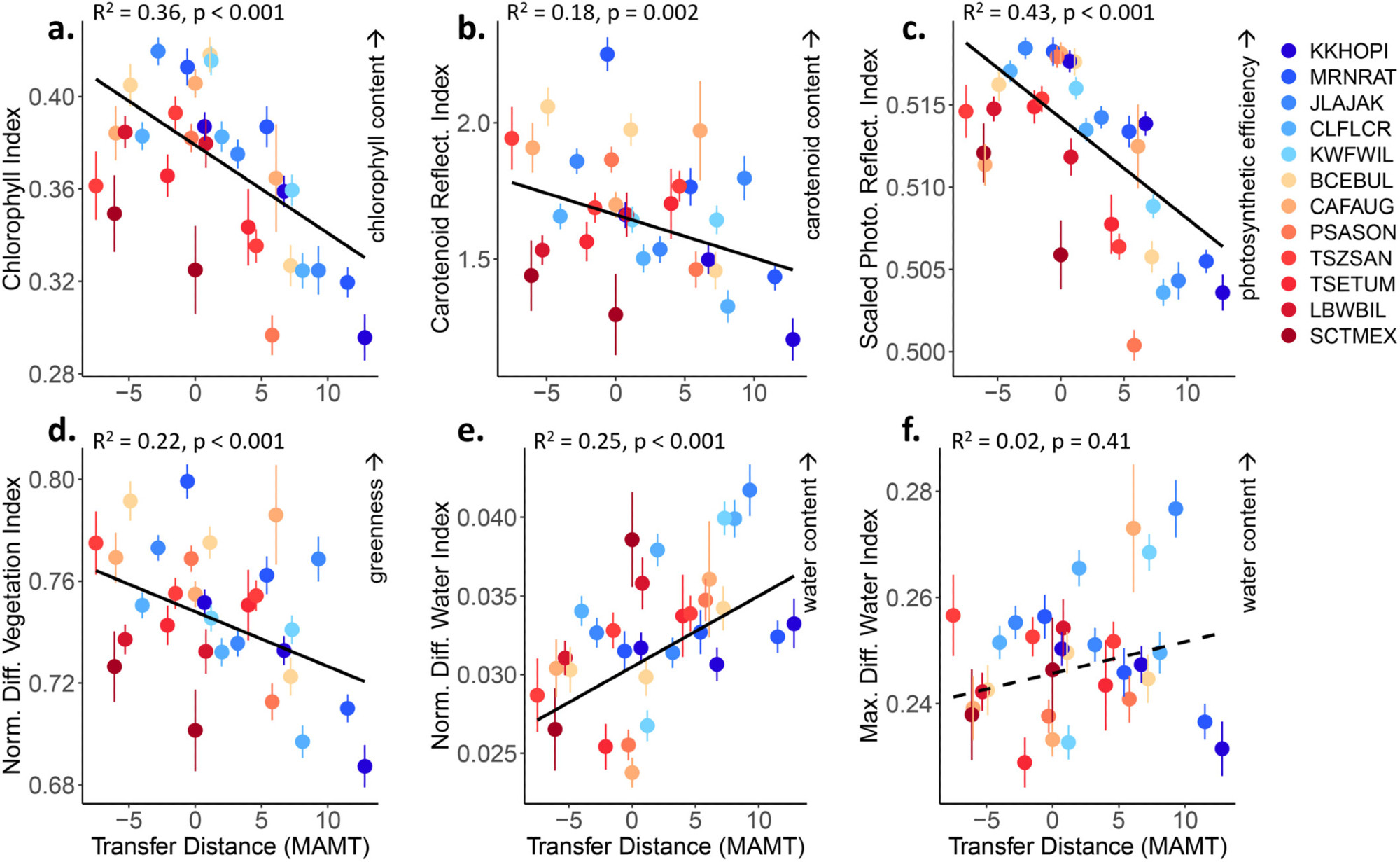
Dr. Jackie Corbin, who now works on actually applying restoration principles with NRCS, used hyperspectral reflectance of Fremont cottonwood leaves growing in multiple common gardens and at home to detect genetic, environmental, and gxe effects on spectral traits https://doi.org/10.1111/pce.15263. She showed we can detect a tree’s population of origin with high accuracy, even in a controlled environment, and also that common spectral indicators of photosynthetic capacity decline as trees are planted in hotter temperatures than they have evolved to deal with. Read all about it, open access in Plant, Cell, and Environment.
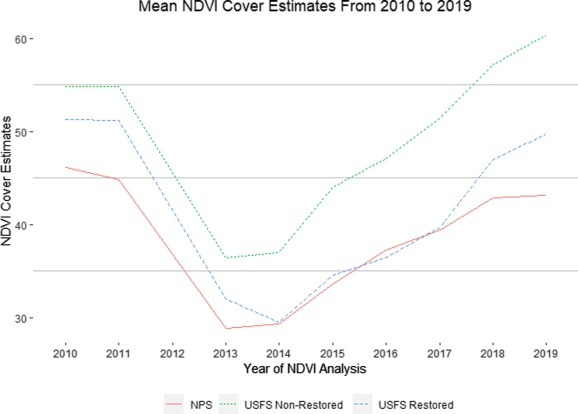
With co-advisor Clare Aslan (NAU SES) and co-author Todd Chaudhry (National Park Service), Sarah found that forest management approaches across multiple agencies shapes ecological responses to major wildfires.
Sterner, S.A.**, C.E. Aslan, R.J. Best, and T. Chaudhry. 2022. Forest management effects on vegetation regeneration after a high severity wildfire: A case study in the southern Cascade range. Forest Ecology and Management 520: 120394. link
Using the Reading Fire as a case study crossing Lassen National Park and Lassen National Forest boundaries, Sarah showed that both management before a fire, such as fire suppression or harvesting, and management after a fire, such as restoration and replanting, shaped the composition and density of forest vegetation. Sarah combined both field surveys and remote sensing to assemble both short and long-term perspectives on fire and forest management, which is increasingly important to understand across the warming American West. You can read her paper here!
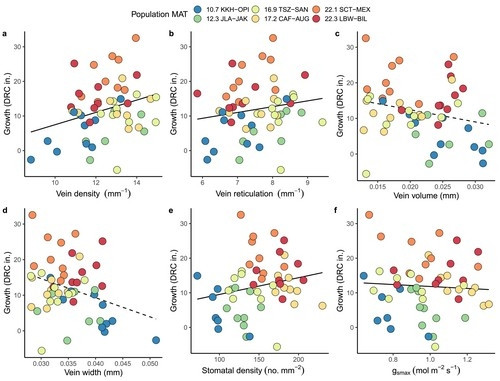
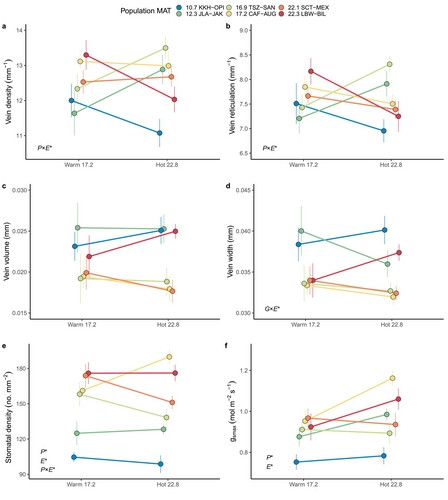
Congrats to former Lindroth Lab postdoc Mike Eisenring (now a Researcher at the Swiss Federal Institute for Forest, Snow and Landscape Research) on this great new paper about intraspecific variation in phenotypic plasticity! Mike found that cottonwood trees from cooler climates show higher plasticity in defensive chemistry in response to both climate and herbivory, until you stress them out with a combination of both. Great collaboration between UW Madison and cottonwood ecologists at the NAU Center for Adaptable Western Landscapes, supported by our Bridging Ecology and Evolution NSF grant!
Eisenring, M., R.J. Best, M.R. Zierden, H.F. Cooper, M.A. Norstrem, T.G. Whitham, K. Grady, G.J. Allan, and R.L. Lindroth. 2022. Genetic divergence along a climate gradient shapes chemical plasticity of a foundation tree species to both changing climate and herbivore damage. Global Change Biology. open access link
Master’s student Iris Garthwaite defended her MS and ALSO was awarded an NSF GRFP and an NAU Presidential Fellowship this week! Big things ahead! We’re so lucky to have you in the lab Iris!


Master’s student Yazhmin Dozal was selected as a Wyss Scholar this year! Yazhmin will work with the National Forest Foundation as a policy intern with ESP and Wyss alum Sasha Stortz this summer, and will go on to great things in conservation leadership (after finishing her research!).
J.R. Jeplawy, H.F. Cooper, J. Marks, R.L. Lindroth, M.I. Andrews, Z.G. Compson, C. Gehring, K.R. Hultine, K. Grady, T.G. Whitham, G.J. Allan, and R.J. Best. 2021. Plastic responses to hot temperatures homogenize riparian leaf litter, speed decomposition, and reduce detritivores. Ecology 102:e03461. link
Riparian ecosystems are shaped by leaf litter traits that depend on both local adaptation and plasticity across a climate gradient. MS student Joann Jeplawy used 6 populations and 3 common gardens of Fremont cottonwood across Arizona.
She found that trees growing in hot conditions made small and fast-decomposing leaves, whereas cold conditions allowed trees from different origins to express a wide range of traits and decomposition rates.
 Congrats to undergrad researcher Yazhmin Dozal, the Distinguished Senior for the College of the Environment, Forestry, and Natural Sciences (CEFNS)!
We’re recruiting a fully-funded Master’s student to find ways to save the Southwest from invasive crayfish! In collaboration with David Ward and Charles Drost at #USGS_SBSC, and with funding from @USFWSSouthwest. 
You must be logged in to post a comment.